Key Takeaways
- Cap table structure affects fundraising velocity, negotiation leverage, and long-term optionality.
- Small checks aren’t the issue — fragmented investor entries are.
- Pooling structures (SPVs, RUVs, CVs) help founders stay fast without excluding supporters.
- Clean cap tables reduce legal overhead, consent delays, and diligence friction.
- Learn how founders balance fractional ownership with operational clarity.
Most fundraising advice focuses on valuation, lead investors, or how to pitch. Very little covers the quiet, structural decisions that shape every future round: how your cap table is organized.
Founders often hear: “Keep your cap table clean.”. Few are told why it matters — or how complexity shows up later.
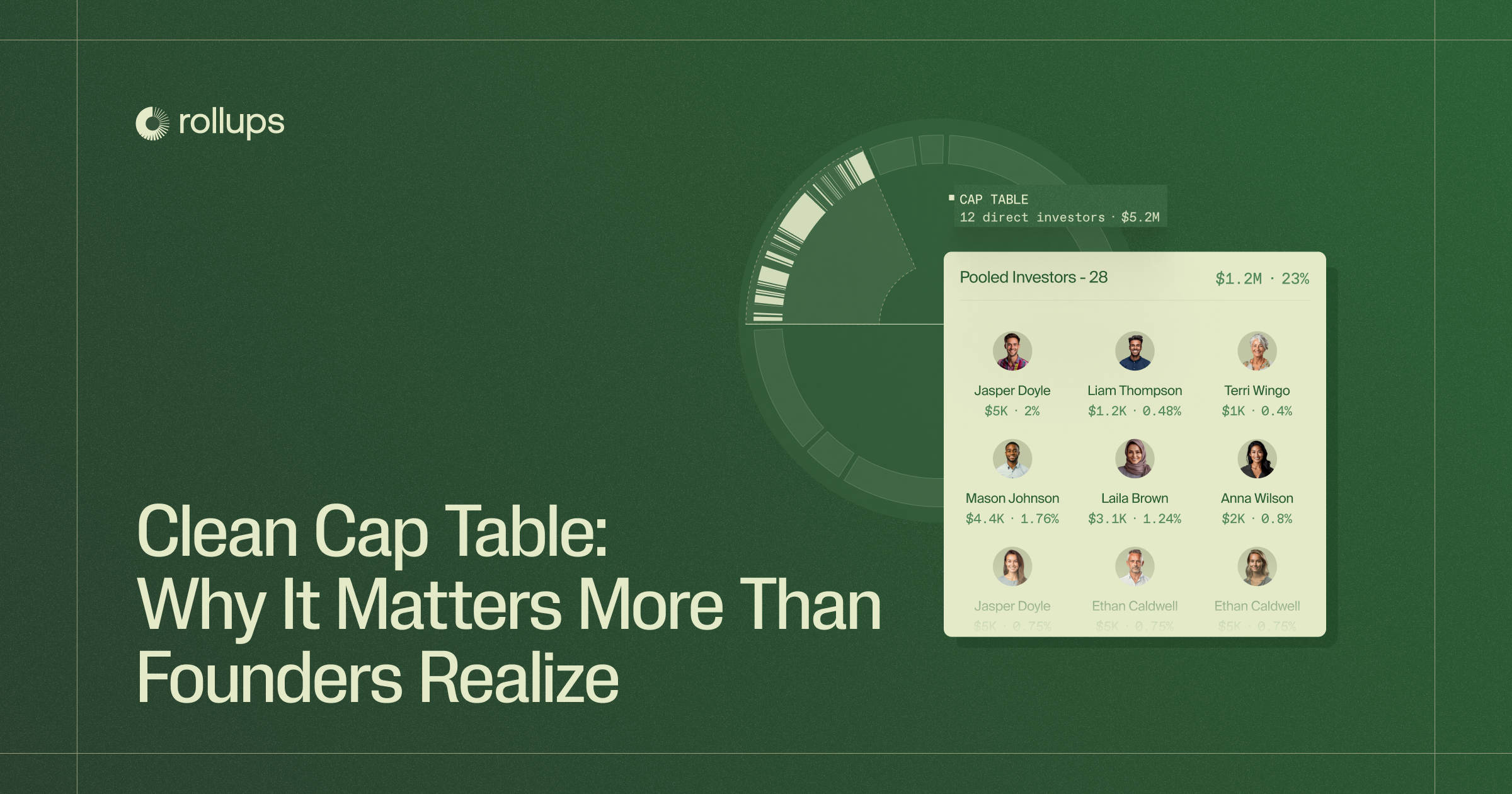
Early on, every check feels meaningful. Operators, angels, friends, advisors, ex-colleagues — you want them with you. They genuinely help. But if each one becomes a separate entry on the cap table, the structure that supports your company starts to work against you.
This isn’t about neatness. It’s about how quickly you can move when something important needs to happen.
Cap Tables Don’t Get Messy Overnight
..they creep up.
A few SAFE holders here. A couple of small checks there. A customer who wants to invest $5k. An early believer you don’t want to turn away.
Sooner or later, each adds:
1. Admin to close and manage (sign, wire, etc)
2. Their own cap table entry
3. Their own rights and approval later
Nothing breaks immediately. But by the time you hit your next round, you’re suddenly carrying 10-30 individual stakeholders from the last round…and every important moment starts taking longer.
Where It Surfaces (Always at the Wrong Time)
Diligence drags
What should be a simple review could turn into a long thread of clarifications. Future investors don’t mind complexity — they mind unpredictability.
A scattered cap table introduces both.
Consents stall
Any corporate action that requires signatures can quickly become a mini-project. Someone’s on vacation, someone doesn’t check their inbox, someone’s using an old email address.
A single slow signer can hold up an entire round.
Legal costs rise quietly
More individuals → more docs → more coordination.
By the time the invoice lands, it’s already too late to unwind the complexity.
Leads get uneasy
Leads won’t say it directly, but they notice when a company’s structure feels fragile.
A fragmented cap table suggests:
1. future approvals might be slow,
2. key decisions could get blocked accidentally, and
3. the founder may not have thought enough about operational scalability.
None of these kill a deal on their own — but they can raise questions that weren't there before.
The Real Issue: Decision Points, Not Investors
Founders often think the solution is “fewer angels.”
That’s not it.
You want more people who believe in you — the ones who pick up the phone, make intros, unblock hires, and give hard feedback at 2am.
The problem is fragmentation, not participation.
Clean cap tables come from reducing the number of entries, not the number of people supporting you.
So How Do Founders Keep Their Cap Table Lightweight
Different tools solve different problems.
The key is choosing structure intentionally — not as an afterthought.
-
Direct checks (simple and clean for large investors)
Great for leads and top angels. Not sustainable for dozens of supporters. -
Roll Up Vehicles (ideal as pro-active solution for new investors)
Useful when pooling individual checks in each round. One signature, fewer moving parts, cleaner future rounds. -
Consolidation Vehicles (ideal as reactive solution to legacy complexity)
When the mess already exists, CVs allow companies to merge legacy holders into one structure post-round. -
Tight early-stage equity design
Avoid unnecessary security types. Complexity compounds.
None of these structures are “right” in isolation. They’re right in the context of how your company is raising and who you’re bringing in.
A Quick Health Check for Your Cap Table
Founders often find this simple test helpful:
- More than 10–15 individual investors?
- SAFEs + notes + equity + advisor grants at once?
- Investors across 5+ jurisdictions?
- Would collecting 100% consent take more than 48 hours?
- Would a new lead feel confused by the structure?
If you hesitate on more than one, it’s worth planning ahead.
Clean Cap Tables Create Optionality
Fundraising, acquisitions, secondaries — the fastest companies in these processes almost always share one trait: predictable, lightly-structured cap tables.
A clean cap table helps you:
- Move faster
- Reduce legal drag
- Build investor confidence
- Operate without surprises
- Include strategic angels without paying for it in complexity
Cleanliness isn’t about control.
It’s about reducing friction so your company can move when it matters.
Ready to Keep a Clean Cap Table?
If you're a startup looking for an investment vehicle for your next round, Roll Up Vehicles are the only solution built specifically for you.
If you're a looking for an vehicle to consolidate existing investors before your next round, Consolidation Vehicles are the only solution built specifically for you.
Speak to our team today: to learn about how you can keep a clean cap table.
Frequently Asked Questions
What does a “clean cap table” actually mean?
A structure that’s simple to explain, quick to execute against, and easy for future investors to diligence.
How many investors is too many?
There’s no universal rule, but complexity typically shows up once you pass ~10 direct individuals in each round.
Do small checks make the cap table messy by default?
No. Small checks only create issues when each one becomes a separate cap table entry. You can take as many small checks as you want — as long as they’re pooled through a clean structure.
When is the right time to think about cap table structure?
Earlier than most founders think. Once you know you’ll have multiple individual investors, it’s worth planning your approach before the round gets busy.
How do founders include many angels without cluttering the cap table?
Founders use RUVs to consolidate investors into one line, as they are compliant, simple and preserve investors individual economics.
Do future VCs or acquirers care about this?
Most do — not because they’re picky, but because complexity slows down everything that happens later.
Can existing complexity be fixed?
Often, yes. Consolidation Vehicles help companies simplify existing complexity without needing to remove supporters or create tax impacts.
Are RUVs only for U.S. companies?
Not necessarily. Many non-U.S. companies use RUVs as a compliant way to pool U.S. investors — and often international investors as well — into a single structure.